Paper Airplane Lab
Fold three different planes, then run a flight test to see which design glides the farthest. A craft and a science experiment in one.
- Time
- ⏱️ 20 min
- Difficulty
- ●○○ Easy
🎬 Watch the video
What you'll need
- A few sheets of A4 paper
- A marker to label each plane
- Tape measure or a long hallway with floor tiles to count
Make it, step by step
Follow the pictures — one fold at a time.
- 1
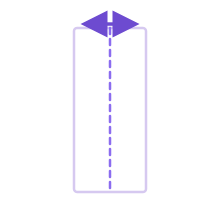
Put your A4 paper in portrait shape. Fold it in half the long way, press the crease, then open it again.
- 2
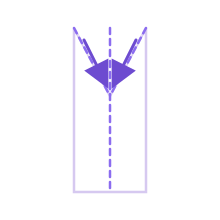
Fold the two top corners down so they touch the centre line. You should have a neat triangle at the top.
- 3
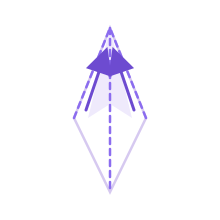
Fold the new slanted edges into the centre line again. This makes a long, sharp nose.
- 4
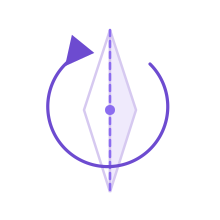
Fold the whole plane in half along the centre crease. Keep the folded flaps on the outside.
- 5
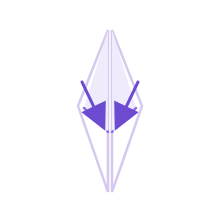
Fold one side down to make a wing, then turn it over and make the other wing match.
- 6
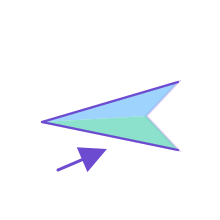
Pinch the bottom, lift the wings, and your dart is ready for a test flight.
Three folds, one flight test. The trick that turns “fold a plane” into a real afternoon is comparing designs — give each plane a name, throw it three times, and keep the best distance. Suddenly it’s a tournament.
Fold three contenders
- The Dart — classic, fast, nose-heavy. Folds to a sharp point.
- The Glider — wider wings, blunt nose. Slower but floaty.
- The Stunt — short and wide with the wings turned up at the tips.
(Any three planes you know will do — the point is that they’re different.)
Run the flight test
- Mark a throwing line on the floor.
- Each plane gets three throws; record the longest.
- Throw the same way each time so it’s a fair test.
Use the prompt below to print a tiny results table and a question to investigate (“Do wider wings always fly farther?”).
What’s really happening
Wider wings make more lift but also more drag, so a glider floats but a dart goes faster and farther in a straight line. Turning the wingtips up helps a plane fly straight instead of rolling. Let your kid form a theory before the test — then see if the planes agree.
✨ Prompts to remix it
Paste into ChatGPT (or any assistant) to generate fresh content in seconds.
Help me turn folding paper airplanes into a simple science experiment for a 7-year-old.
Give me: (1) one clear question to test, (2) a 3-column results table to fill in
(Plane name, Throw 1, Throw 2, Best distance), and (3) two kid-friendly sentences
explaining why wing shape changes how far a plane flies. Keep it short.